The UN’s International Literacy Day is in its 60th year, with this anniversary reflecting on six decades of world progress in literacy. One piece of progress we celebrate is the expansion in education access across this period, as rates of school attendance have continued to rise since the 1970s. However, the global learning crisis reminds us that more children attending school is only half the job, we need to ensure that they are actually learning.
The headlines that surround literacy, such as ‘739 million people are still illiterate’, present literacy as a ‘have or have not’ idea, yet when we look beyond the classroom and consider how a child can successfully apply their education to the wider world, it’s much more than this: it’s a trajectory, not a binary state.
A rise in a ‘percentage of population literate’ figure is an important measure of a country’s progress in education, being one of the metrics considered towards a country’s progress towards the fourth Sustainable Development Goal (SDG) of ‘Quality Education’. The SDG indicator describes literacy as “the percentage of people who can both read and write a short simple statement on everyday life with understanding.” Globally, the rate of people able to do this over the past two decades has risen steadily.
However, while being able to read and write a sentence puts you into a positive statistic, it does not empower. If we expect children to interpret, comprehend and analyse to access decent work opportunities and personal growth, we need to look at functional literacy. UNESCO defines literacy as “a means of identification, understanding, interpretation, creation, and communication in an increasingly digital, text-mediated, information-rich and fast-changing world.” This recognises that in order to progress as a society, literacy clearly needs to be world-applicable, rather than achieving a minimum benchmark.
If literacy is about application rather than ticking a box, then educational projects must recognise this through thoughtful monitoring of progress. In READ Foundation’s literacy-focused projects we do exactly this.
Our School on a Boat project in waterlogged Kishoreganj, northeastern Bangladesh, focuses on children whose access to school is threatened by geography and climate. By enrolling out-of-school children – largely from illiterate families – in a programme that includes Bangla and English, they are learning to read and write, building on those skills as they move up a grade each year. Although the education programme is non-formal, it uses a government-accredited curriculum with periodic assessment, meaning that the progress they make each year is accepted as equivalent to the formal grade system.
In Ethiopia, the goal of our READing Project is to improve reading proficiency in schools in an education system under strain from the ongoing civil conflict. Implementing a package of support that primarily involves teacher training in innovative play-based techniques, learner’s progress is verified by the percentage of children who achieve a minimum reading proficiency level at the end of the project compared to a baseline.
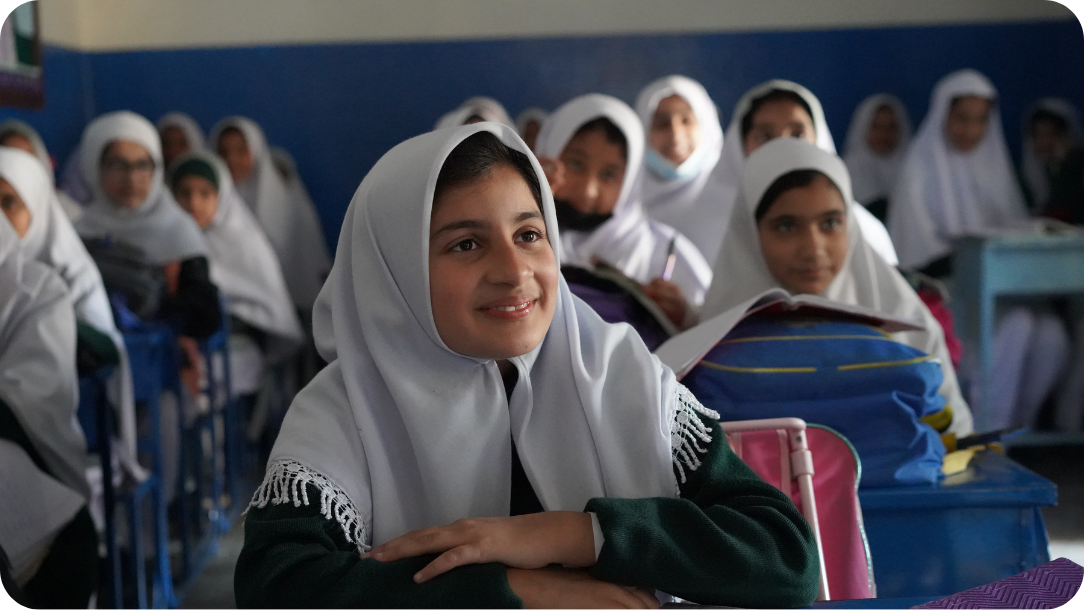
Through our Empower Her Project in Sindh, Pakistan, girls’ reading and numeracy skills were assessed when they first enrolled in the Community-Based Accelerated Learning Spaces, and their learning was tracked through regular assessments over the course of the programme. Results were independently validatedusing adapted Early Grade Reading Assessment (EGRA) tools, providing robust evidence of improvements in foundational literacy and numeracy skills.
As READ observes International Literacy Day, it reminds us to pay attention not just to literacy itself, but how we must frame it as a journey towards onward progress, something especially important in the face of the global learning crisis which emphasises that quality teaching is just as important as access to education.